
Showing posts with label Japanese language. Show all posts
Showing posts with label Japanese language. Show all posts
Thursday, March 8, 2012
For Now — Sayonara
I have to thank echosquirrel for introducing me to The Books. They're an American duo whose first album Thought for Food came out way back in 2002.
Tokyo is from their second album, The Lemon of Pink (2003). I love how at about the 1:21 mark of this video the flight attendant says: "We hope you have enjoyed the flight.... And for now — sayonara."
For an English speaking person sayonara really just means goodbye. But in Japanese, it seems to me, it means "goodbye, I probably won't see you again for a while" which is somewhat at odds with the for now. Sayonara is more like "farewell", so you really don't hear it that often.
There are lots of other ways to say a more temporary goodbye, like when leaving work one says otsukara sama deshita which I like translating, somewhat ridiculously, as "I salute you, oh tired one!" or "Thank you for working so hard!" (The assumption being that everyone always works hard.)
Then there's jâ ne! (More woman's language than men's, meaning "see ya".) Or ja, mata ashita. (See you tomorrow.) Or ato de (later). Or the terrible schoolgirl "bai-bai!"
Anyway, for now, sayonara. I hope you have enjoyed the flight.


Tuesday, March 22, 2011
Now and Then


While the fruit seem grumpy, the girl is definitely contemplative, a nice contrast to the present day almost unremitting cheery, chipper cartoon images all around us.
The boxed, two-volume set is a compilation of the greatest hits from the journal Kodomo no Kuni (Kids' Land) which was published monthly, mostly in the 1920s, 30s, with a few issues in the 40s. You can learn more about the history of it here, but I first came across some of the images here. The bottom picture shows the magazine cover for the January, 1922 issue.
One of the interesting aspects of the boxed reprint is that the designers elected to erase the magazine's original title, which read from right to left, and replace it with a more modern version reading left to right. Below is the original with the katakana reading from right to left.

You still occasionally see print reading from right to left here — on the side of a boat or an old sign — but I suspect the practice was abruptly ended at the conclusion of World War II.
I'll have to do a little research and get back to you.
Saturday, March 19, 2011

Wednesday, March 9, 2011
Move Over Odwalla!
I used to live in California, so green drinks don't necessarily scare me, but green drinks nestled in among the single-serve coffees in the convenience store are a bit perplexing, especially when the jar's label is entirely in kanji.
 I figured the little guy must be drinkable since it was sitting in among the "regular" drinks, so I picked one up and went to the counter to find out what I would be consuming.
The girl there knew as little as I did — but we both agreed it was a rare thing I had picked up and was probably healthy for me.
It was only 105 yen (about $1.27 at today's exchange rate) so I went for it.
I stuffed the drink in my bag and jumped in a cab to get to work.
When I got there, I had a few minutes of down time, so I turned the cute little green bottle around to see if I could glean anything else:
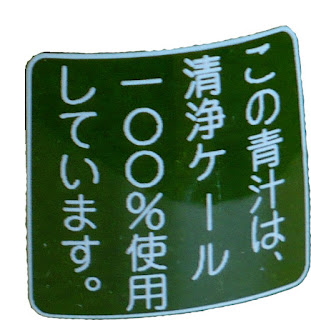
Ah! 100% kale. That I could understand.
I peeled off the lid and lifted it to my lips with all the faith of an aboriginal sampling a new fruit. Fresh and cold and a little chunky. I'm sure it was good for me.
Back at home I looked up the name of my drink: Endo's Medium Blue-Green Juice from Kochi.
It's made locally and the bottles, I think, are returnable. And it's a lot cheaper than Odwalla. I give it a slightly reserved thumbs-up.

The girl there knew as little as I did — but we both agreed it was a rare thing I had picked up and was probably healthy for me.
It was only 105 yen (about $1.27 at today's exchange rate) so I went for it.
I stuffed the drink in my bag and jumped in a cab to get to work.
When I got there, I had a few minutes of down time, so I turned the cute little green bottle around to see if I could glean anything else:

Ah! 100% kale. That I could understand.
I peeled off the lid and lifted it to my lips with all the faith of an aboriginal sampling a new fruit. Fresh and cold and a little chunky. I'm sure it was good for me.
Back at home I looked up the name of my drink: Endo's Medium Blue-Green Juice from Kochi.
It's made locally and the bottles, I think, are returnable. And it's a lot cheaper than Odwalla. I give it a slightly reserved thumbs-up.
Monday, March 7, 2011
Ate & Ape
Negotiating the visual and textual landscape in Japan can be perplexing enough: not only are there the Chinese characters, or kanji, but there are two syllabaries — hiragana and katakana — the latter reserved mostly for loan words from whatever language; additionally there is a large smattering of words from English written in Roman characters, romaji, which are sometimes English and at other times English-ish. This last category often is the most perplexing.

Simple enough, right?
Not really, because it makes no sense in English. In Japanese, it is nicely ambiguous, since "a té" could mean an aim or an end (当て)or, with another character, (あ、手)it would read "Oh! a hand."
"Este" (エステ)is short for the French esthetique. In Japanese it means beauty salon or in some cases cosmetic surgery.
So there's some pretty hard mixing going on here.
Same day, different location:

It's French, or a kind of French I guess, but for the English reader it's comedic because we immediately associate it with the animal who sadly has no opposable thumb with which to bake. The Japanese pronunciation, like in the first example, turns the e into a long a. A pays. (But don't pronounce the s. In French. And I'm sure I'm missing an accent mark somewhere.)
Ah, language. C'est comme manger un singe.
Sunday, March 6, 2011


Friday, February 25, 2011


Subscribe to:
Posts (Atom)