
Saturday, February 18, 2012


Wednesday, February 15, 2012
My New Favorite Print Mag in Japan

I'll have to do a lot of plain living to plow through all those pages. I guess I'll start with the pictures and manga and work my way up to the high-thinking pieces. With any luck I'll be done by spring in time for No. 40.
Monday, February 13, 2012
Happy Belated Birthday Charles
203 years ago yesterday, in Shropshire, Englsnd, Charles Darwin was born. Fifty years later he published On the Origin of Species, his masterwork which built up — through countless examples and anecdotes, as well as evidence from the fossil record, animal husbandry, and his own observations onboard The Beagle — the case for evolution by natural selection.
Now I don't know if he was the first to enumerate the myriad ways in which seeds get dispersed in order to propagate their kind, but he did do various interesting experiments in that realm such as immersing many different varieties of seeds in seawater for days and weeks on end to see if they had the staying power to survive trans-oceanic voyages intact and still germinate (many could, even after a month.)
Here's Darwin on seed dispersal:
Whenever I go running in the late fall or winter around here, I can't help coming back with clumps of the seed pods of this guy stuck in my gloves or socks.
 We'll have to amend Darwin's paragraph to read: "Or adhere to the smart wool of bipeds."
Now I don't know if he was the first to enumerate the myriad ways in which seeds get dispersed in order to propagate their kind, but he did do various interesting experiments in that realm such as immersing many different varieties of seeds in seawater for days and weeks on end to see if they had the staying power to survive trans-oceanic voyages intact and still germinate (many could, even after a month.)
Here's Darwin on seed dispersal:
Seeds are disseminated by their minuteness, by their capsule being converted into a light balloon-like envelope, by being embedded in pulp or flesh, formed of the most diverse parts, and rendered nutritious, as well as conspicuously coloured, so as to attract and be devoured by birds, by having hooks and grapnels of many kinds and serrated awns, so as to adhere to the fur of quadrupeds, and by being furnished with wings and plumes, as different in shape as they are elegant in structure, so as to be wafted by every breeze.

Sunday, February 12, 2012
A Couple of Old Western-Style Houses Around Town


Saturday, February 11, 2012
The Giant Peach
An XSO* of mine once said to me after I related to her a particularly vivid dream: "Edward (or, Edouard, as she called me) you shouldn't confuse your dreams with reality."
I had and still have a hard time with that prohibition — I've never wanted to regard it as wishful thinking to tell myself that my waking life could be as fast-paced and fraught with adventure, danger, and romance as my dreams.
I do think she was admonishing me more for trying to figure out what my dreams meant more than for me wanting them to be actualized; for trying to impart significance on a phenomenon none of us really knows all that much about.
So the other night when I dreamed I had discovered, up in the mountains, a tree with enormous peaches, peaches the size of footballs, pink and glistening with dew, so mouth-wateringly juicy that I had to collect as many as I possibly could and bring them back down to town for canning, I wasn't quite satisfied when I woke up to look out the window at the quiet winter landscape with the bare biwa trees and even barer fields.
I did feel however, that the dream was a good omen, for what I can't tell, and there was, when I got down from the tree with the peaches in my shirt, a little steam train just off through the clearing, hard by the sea, all black and Victorian and coquettish, waiting to take me away to I know not where.
And the residue of the dream, nagging me all day, pointed me to a story I had for some reason never read: Roald Dahl's James and the Giant Peach.
And in that charmingly sinister story, which I won't relate in detail here so as not to bore you, the boy James escapes from his wicked Aunts (Ants as we call 'em in the Northeast) inside an enormous peach, lifted across the Atlantic from England to America by seagulls and spider thread.
I can assure you that I am not coming back in or on a giant peach, though I am waiting for someone to slip through the hedge and hand me a sack of slithering beans. Who knows what I'll do with them — I'll have to consult my dreams.
I had and still have a hard time with that prohibition — I've never wanted to regard it as wishful thinking to tell myself that my waking life could be as fast-paced and fraught with adventure, danger, and romance as my dreams.
I do think she was admonishing me more for trying to figure out what my dreams meant more than for me wanting them to be actualized; for trying to impart significance on a phenomenon none of us really knows all that much about.
So the other night when I dreamed I had discovered, up in the mountains, a tree with enormous peaches, peaches the size of footballs, pink and glistening with dew, so mouth-wateringly juicy that I had to collect as many as I possibly could and bring them back down to town for canning, I wasn't quite satisfied when I woke up to look out the window at the quiet winter landscape with the bare biwa trees and even barer fields.
I did feel however, that the dream was a good omen, for what I can't tell, and there was, when I got down from the tree with the peaches in my shirt, a little steam train just off through the clearing, hard by the sea, all black and Victorian and coquettish, waiting to take me away to I know not where.
And the residue of the dream, nagging me all day, pointed me to a story I had for some reason never read: Roald Dahl's James and the Giant Peach.
And in that charmingly sinister story, which I won't relate in detail here so as not to bore you, the boy James escapes from his wicked Aunts (Ants as we call 'em in the Northeast) inside an enormous peach, lifted across the Atlantic from England to America by seagulls and spider thread.
I can assure you that I am not coming back in or on a giant peach, though I am waiting for someone to slip through the hedge and hand me a sack of slithering beans. Who knows what I'll do with them — I'll have to consult my dreams.
*Ex-Significant Other
Wednesday, February 8, 2012
Winter Lull

Friday, February 3, 2012
Quiet
Quiet, I see, has been making the rounds in the past week. Not real quiet, the kind that hardly needs a book, just the talking of it, the pitching of it, the trotting of it out.
In her new book subtitled "The Power of Introverts in a World That Can't Stop Talking," Susan Cain argues that there is "a severe bias against introversion" in our society. Talking, for instance, about how our workplaces are designed, she says that they have been set up for maximum group interaction — open-plan offices without walls which results in very little privacy. A playground for extroverts. A barbaric Colosseum for those more inwardly inclined.
I don't know. I've been in densely packed cafés with music blaring where I was so intensely focused on my position in chess that I literally couldn't see or hear another thing. So it's not always a matter of space, but rather one's mental focus within it.
Edward Champion has a nice interview with her here where he pushes back at some of her neat categorizations. She does do a nice job of articulating her ideas — I guess when you've spent six years researching and writing about one subject you will know your shit.
Anyway, reading and listening to some of the discussions got me to thinking about the structure of Japanese institutions. What, for example, are Japanese companies designed for? Group consensus, or individual slave labor and paper shuffling?
Here's an example of a lay-out of a typical office from JTB's Ilustrated "Salaryman" in Japan:
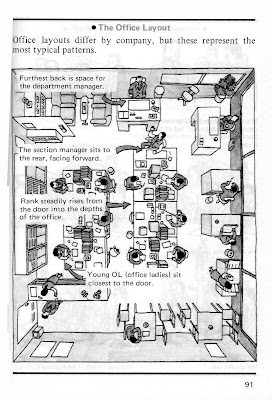 The only thing I can say for sure is that Japanese offices are quiet. And that probably has more to do with the temperament of the people than the layout of the space.
I regularly pass through these mausoleums on my way to teach company classes. Sometimes there are small groups talking, but never so loudly as to interrupt or bother the work of others.
I find it interesting too that the words for both company and shrine share the character sha 社 as in kaisha and jinja.
In her new book subtitled "The Power of Introverts in a World That Can't Stop Talking," Susan Cain argues that there is "a severe bias against introversion" in our society. Talking, for instance, about how our workplaces are designed, she says that they have been set up for maximum group interaction — open-plan offices without walls which results in very little privacy. A playground for extroverts. A barbaric Colosseum for those more inwardly inclined.
I don't know. I've been in densely packed cafés with music blaring where I was so intensely focused on my position in chess that I literally couldn't see or hear another thing. So it's not always a matter of space, but rather one's mental focus within it.
Edward Champion has a nice interview with her here where he pushes back at some of her neat categorizations. She does do a nice job of articulating her ideas — I guess when you've spent six years researching and writing about one subject you will know your shit.
Anyway, reading and listening to some of the discussions got me to thinking about the structure of Japanese institutions. What, for example, are Japanese companies designed for? Group consensus, or individual slave labor and paper shuffling?
Here's an example of a lay-out of a typical office from JTB's Ilustrated "Salaryman" in Japan:

I regularly pass through these mausoleums on my way to teach company classes. Sometimes there are small groups talking, but never so loudly as to interrupt or bother the work of others.
I find it interesting too that the words for both company and shrine share the character sha 社 as in kaisha and jinja.
会社 = company
神社 = shrine
神社 = shrine
Subscribe to:
Posts (Atom)